


Many times we travel for the interest of visiting interesting cities and towns, seeing great monuments or enjoying beautiful landscapes.
But what, without a doubt, often greatly enriches our traveling experience is learn about different cultures and traditions.
Of course a trip to a region like La Rioja Its great attraction is to enjoy its famous wines and deepen your knowledge of the wine tourism.
DON'T FORGET YOUR TRAVEL INSURANCE
Are you planning your trip or getaway? Don't leave without take out your travel insurance before, and here we explain whyIf you contract it with us, you have a 10% discount with the code GUIASVIAJAR10.
But did you know that in La Rioja you can also do fungitourism?
All the information in detail
What is fungitourism
When they proposed it to us in the plan of our last trip through that region, I admit that we did not know what it was about.
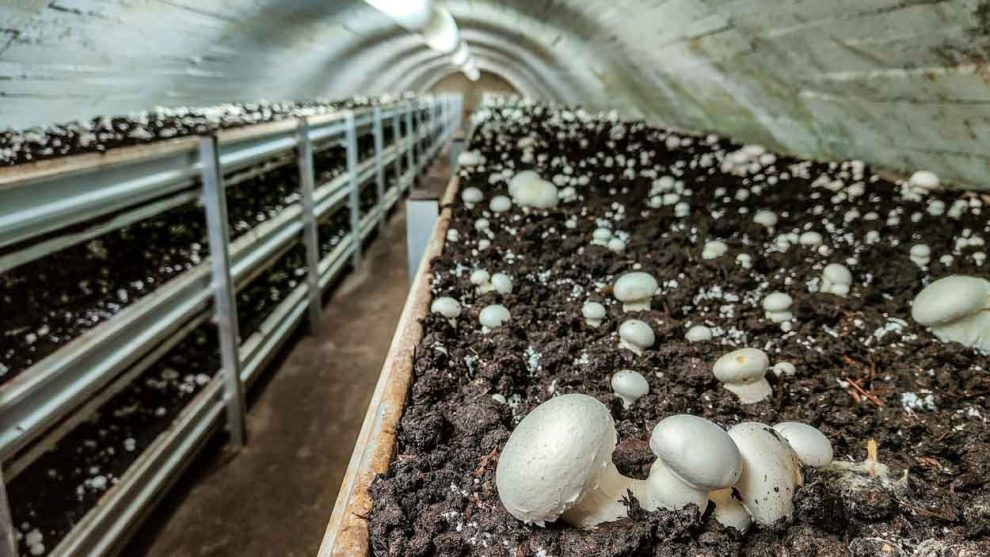
Now we know that fungitourism is the tourist activity that allows you learn about the history and tradition of mushroom and mushroom production, and what better place than the population of Pradejon, the largest producer in Spain.
Until now I didn't know that La Rioja It is currently the leading region in our country in the mushroom production, with 66.000 tons per year, and Pradejon stands out as the main producing municipality, contributing almost half of this figure.
In this regard, La Rioja It ranks third in Europe, behind France and the Netherlands, and competes closely with Poland.

Pradejón and the tradition of mushroom and fungi production
And in particular, Pradejon, with less than 4.000 inhabitants, is known as the mushroom town, and that is part of their identity.
Located just half an hour from Logroño, in the place where an ancient Roman road and the Camino de Santiago del Ebro, as soon as you enter Pradejon you are a witness to that identity.
Indeed, in several places in the center of the town you will see large urban art murals, in some of which (the first one painted in 2014) the mushroom is the main protagonist.
Right next to said mural is the Fungitourism Center, a tourist information space where you will have the first information about this economic activity.
To understand its origin, we must go back to the 17th and 18th centuries, when there was a notable increase in the area of vineyards planted in the municipality, and the Winery District emerged due to the need to have a space to make wines.

The appearance of wine cooperatives starting in the 50s led to the decline of said neighborhood.
Its caves became the ideal place to host the new mushroom cultivation, taking advantage of the spaces that were left free after the formation of the aforementioned cooperatives.
Here you have complete information with Tours, guided visits and activities in La Rioja, among which are the winery visits
This tradition evolved and gave way to the first composting plants in the 70s, and later, in the 80s, to the cultivation of oyster mushrooms and the creation of local seedbeds.
In the late 80s, mushroom growers faced a crisis due to the lack of marketing channels for such a perishable product.

In 1987, they came together and formed ASOCHAMP, the first national association in the sector, which launched the Fungitourism, which in 2020 became managed by the City Council and a foundation.
In the 90s, with all the producers united, the first marketing platforms were established, expanding the offer beyond fresh mushrooms and positioning this Rioja industry as a national leader.
With the incorporation of advanced technology, the varieties of cultivated mushrooms were diversified, such as oyster mushroom and Asian varieties such as shiitake and oyster mushroom, and frozen cultivation was also chosen.
ORGANIZE your TRIP
- Don't forget your TRAVEL INSURANCE with a 10% discount
- Book the HOTEL for your trip
- eSIM card to have INTERNET at a discount
- The best TOURS and EXCURSIONS in Spanish
- TOURS and ACTIVITIES in English and other languages
- NO-LINE TICKETS for museums and monuments
- RENT a CAR for your trip
- Has your flight been cancelled? How to claim compensation
- Book your TRANSFER from the airport
A large plant dedicated to these specific mushrooms was also launched, unique in Europe.
And in 2011, innovation was also made with the creation of the first and only recycling plant in the region, processing waste from mushroom cultivation that was previously discarded.

This is what mushroom tourism in Pradejón is like (our experience)
La fungitourism activity It was born in 2014 and has the aforementioned information center as its starting point.
As we verified in the experience of our visit, when you arrive at the center you begin a tour where, through information panels and videos, you learn how this productive activity is developed and its origins.
This way you will know that fungi are living beings with peculiar characteristics that belong to the fungi kingdom and there are millions of different ones.
It explains what fungi and mushrooms are, their characteristics, with the difference between mushrooms and mycelium, and also talks specifically about the mushrooms grown in Pradejón, the champignon, the oyster mushroom and the two Asian varieties.
They talk about the mushrooms grown in Pradejón, button mushroom, oyster mushroom, and the aforementioned Asian varieties.

It is explained how they reproduce and germinate in the laboratory creating the mycelium, and how it is then mixed with the rye grain, which is the sowing vehicle, until the fungus invades it.
In parallel, the substrate, known as compost, which will be the food for the mushroom.
It is really surprising to know how fast mushrooms grow.
This visit also talks about the health benefits of consuming cultivated mushrooms and how recycling is done, and concludes with the history of mushroom consumption.
It is also interesting to know that a lot of labor is needed for this production, which is why the municipality is very multicultural, with a majority of Moroccan and Romanian immigrants.

How to see the Urban Art route in Pradejón
If the group is small, you have the possibility of making a guided tour of the crop areas, and you can also choose to know the museum wine cellar, with pre-established rates.
On Fungitourism Center They will also provide you with information and a map to make the Pradejón Urban Museum Route, murals that can be visited on your own using an audio guide system accessible by QR.
Schedules and prices at Fungiturism Center
La standard visit It includes the interpretation center, the crops and the museum, lasting approximately two and a half hours, and if you are in a group of at least ten people, a tasting is offered.
However, visits are made even for groups of two people.
The hours of the Pradejón Fungitourism Center They are, Wednesdays to Saturdays, from 10 a.m. to 13,30:16 p.m.; from Thursday to Saturday, also in the afternoon, from 19 to 10,30 p.m.; and on Sundays, from 13,30:XNUMX a.m. to XNUMX:XNUMX p.m.

The prices for the complete visit, information center and museum winery, are, adults, 14 euros, and children from 6 to 12 years, 9 euros.
In short, an enriching experience, the best way to complete it is with a mushroom or mushroom tasting in one of the bars in town.
Map: where Pradejón is and how to get there in La Rioja
Pradejon is half way by car towards the southeast of the city from Logrono, on the border between La Rioja and Navarra, and northwest of Calahorra.
Book your hotel, 15% discount, free cancellation
When planning your trip, we advise you to, well in advance, Book your hotel now on booking.com where you can find discounts from 15% and you will have a possible cancellation for free


Comment