



Cuenca It is one of the 15 cities that Unesco has declared as World Heritage in all Spain.
This distinction is reason enough for it to be considered, like the others, as a good travel destination since it guarantees the existence of a historical set Very well preserved and with some unique features.
La Unesco describe the historic center of Cuenca like a defensive medieval city In excellent condition.
DON'T FORGET YOUR TRAVEL INSURANCE
Are you planning your trip or getaway? Don't leave without take out your travel insurance before, and here we explain whyIf you contract it with us, you have a 10% discount with the code GUIASVIAJAR10.
As both a royal and episcopal city, it abounds in civil and religious buildings of great value that make up a very special group.
Another attraction to take into account is the surrounding landscape, formed by the Sickles of the Júcar and Huécar rivers, which well preserve their pristine character and can be accessed directly by walking from the ancient city.
All the information in detail
- 1 Main attractions for a getaway to Cuenca
- 2 Curiosities of the history of Cuenca
- 3 This is the experience of visiting Cuenca, the best things to see and do
- 3.1 How to get to the center of Cuenca from the AVE station
- 3.2 Old Town of Cuenca, a World Heritage Site
- 3.3 Antonio Pérez Foundation, contemporary art in Cuenca
- 3.4 San Pedro, most important church in Cuenca
- 3.5 Plaza Mayor of Cuenca
- 3.6 Cuenca Cathedral, oldest Gothic cathedral in Spain
- 3.7 Museum of Abstract Art in the Hanging Houses of Cuenca
- 3.8 Best place to photograph the Hanging Houses of Cuenca
- 3.9 Convent of San Pablo, Parador de Turismo
- 3.10 Torner Space, Gustavo Torner collection
- 3.11 Monuments in the Plaza de la Merced
- 3.12 Monument to the Constitution in Cuenca
- 3.13 Civil War Shelters in Cuenca
- 4 How to hike through the Hoces del Júcar and Huécar in Cuenca
- 5 Visit the Paleontological Museum in Cuenca
- 6 Map: where Cuenca is and how to get there
Main attractions for a getaway to Cuenca
This union of medieval fortress city and landscape It creates a very attractive set that is well worth a visit.
Currently you can arrive by AVE from Madrid to Cuenca in just one hour, a little more if we travel in our own vehicle, but it is easily accessible from many other points of the Peninsula.
It is, therefore, a good destination for a Weekend getaway if we want to enjoy a city with a marked historical character, full of monuments and with nature right next to it.

To all this we must add its great importance for lovers of contemporary art as Cuenca It is home to numerous institutions that offer a magnificent panorama of art since the mid-20th century.
And we must not forget the great attraction of Museum of Paleontology, opened in 2015, showing the important discoveries about dinosaurs and other species that have been carried out throughout Castilla la Mancha.
Curiosities of the history of Cuenca
Its peculiar location on a limestone escarpment between the gorges formed by the two rivers was chosen in Muslim times to build a defensive enclave.
From all this derives its peculiar urban development and its close relationship with the surrounding nature.
Alfonso VIII He conquered it in 1177 and began the construction of the cathedral to turn it into a Christian city, although he allowed Muslims and Jews to remain concentrated in their respective neighborhoods.

This is the experience of visiting Cuenca, the best things to see and do
After experience of our visit, I tell you in advance that one of the pleasures of a visit to Cuenca is to wander through the old town streets, discovering at every step interesting corners and different perspectives of the surrounding landscape from the numerous viewpoints that we will find.
Although the historic helmet It is relatively small, there are so many interesting places to discover, that it takes more than a day to get to know them all.
Here you have complete information and you can hire the best tours and guided visits Cuenca, as well as its surroundings, including a Complete tour of Cuenca three hours long, and excursion to the Enchanted City , and also others alternatives in English and other languages
The entire old part of Cuenca is located on a slope, so it is necessary to warn that you need good footwear to walk comfortably.
For this same reason we have organized the essential places to visit in a descending direction to avoid steep climbs as much as possible.
Although it is clear that it will be impossible not to encounter one of them, even if only to return to the main route after having taken a detour.
How to get to the center of Cuenca from the AVE station
If you do not want to or cannot walk to the highest part, you should know that it can be easily reached by taxi or bus line L2.
La line L1 It only reaches the Plaza Mayor and has its origin in the AVE station.
ORGANIZE your TRIP
- Don't forget your TRAVEL INSURANCE with a 10% discount
- Book the HOTEL for your trip
- eSIM card to have INTERNET at a discount
- The best TOURS and EXCURSIONS in Spanish
- TOURS and ACTIVITIES in English and other languages
- NO-LINE TICKETS for museums and monuments
- RENT a CAR for your trip
- Has your flight been cancelled? How to claim compensation
- Book your TRANSFER from the airport
Old Town of Cuenca, a World Heritage Site
We can start the tour at Bezudo Gate, which opens in the remains of the castle.
To cross it from the outside you have to cross a bridge built over the moat carved into the Middle Ages on the living rock.

We then enter the intramural enclosure of the historic Cuenca, which shows its extraordinary set of architecture of medieval origin and where abound palaces and religious buildings.
Two of them stand out on our left side.
The first is former Court of the Inquisition, which now serves as the headquarters of the Provincial Archive.
Antonio Pérez Foundation, contemporary art in Cuenca
The second is the old Convent of the Descalzas, now occupied by the headquarters of the Antonio Pérez Foundation, which also has important spaces in San Clemente, Sigüenza y Huete.
If we are minimally interested in contemporary spanish art, the Antonio Pérez Foundation it is a must see.

In fact, we can say that it is currently one of the essential visits we can make in Cuenca, although it may not be a well-known place.
Here we find work of Saura, Thousands, Canogar, Done or Chronicle Team, among many other fundamental names.
San Pedro, most important church in Cuenca
Practically next to it, the mass of the St. Peter's Church, the most important in the entire old town after the Cathedral.
It was built on an old mosque and draws attention for its octagonal plan.
La visit to the church, With the climb to the tower, there is a fee, but there is the possibility of combining it with that of the cathedral at the same entrance.

You should not miss the numerous viewpoints that appear on both sides as we go down this area.
If we go down the San Pedro street, we will see on the right hand side an arch that takes us to the Saint Nicholas Square.
There is the Zavala house museum, a palatial building from the 18th century that now houses various exhibitions.
A very steep slope, Descent into Anguish, drives through a very picturesque place to a old convent and the Hermitage of the Virgen de las Angustias, In Júcar sickle.
Plaza Mayor of Cuenca
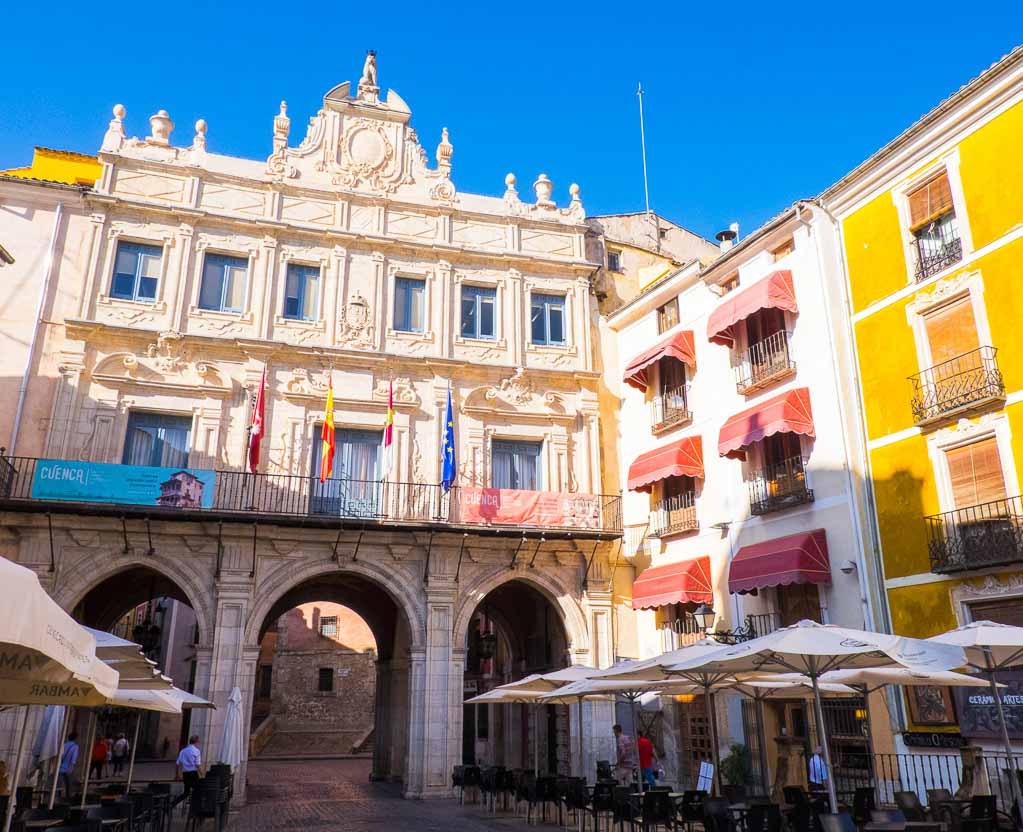
If we follow the natural descent of the main street we arrive at the Plaza Mayor, the center of urban life in the old town.

It is a rather irregular set in which it stands out Cathedralbut also the Town Hall and the Petras Convent.
We will also see several bars and restaurants that take their tables to the square.
Cuenca Cathedral, oldest Gothic cathedral in Spain
La Cuenca Cathedral It does not impress much at first glance due to its poorly decorated façade and lack of towers, but it is a true artistic and historical treasure.
Book your hotel, 15% discount, free cancellation
When planning your trip, we advise you to, well in advance, Book your hotel now on booking.com where you can find discounts from 15% and you will have a possible cancellation for free
Competes with that of Avila in considering the oldest gothic cathedral in Spain.
Its interior, with different Renaissance and Plateresque chapels, it is worth seeing.
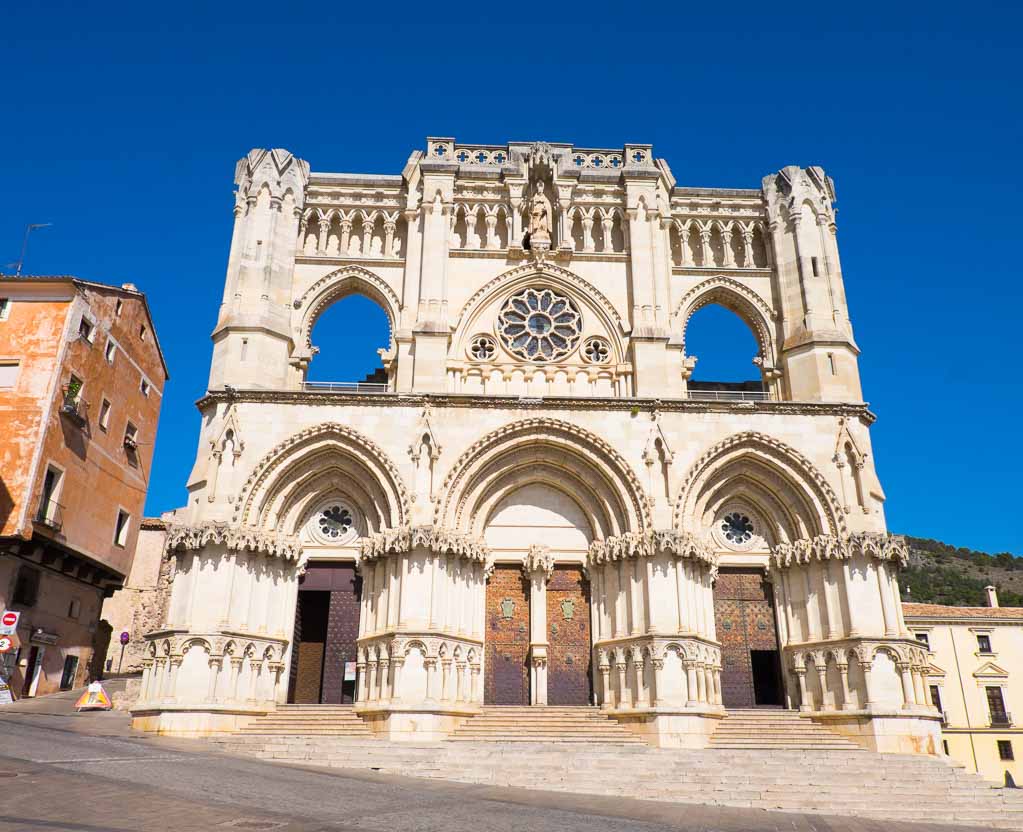
In the complex we must highlight the monumental Arch of Jamete which allows passage to the cloister and is considered a masterpiece.
If we skirt the cathedral along the Obispo Valero street, we will see the Episcopal palace and large statue of Alfonso VIII.
From Ronda square there is a good view of the San Martin neighborhood, where are the houses called the skyscrapers of Cuenca.
Museum of Abstract Art in the Hanging Houses of Cuenca
Here is also the entrance to the Museum of Spanish Abstract Art, which occupies a good part of the famous Hanging houses.
This museum is one of the fundamental visits in Cuenca, with work by the most representative artists of the spanish abstract movement.
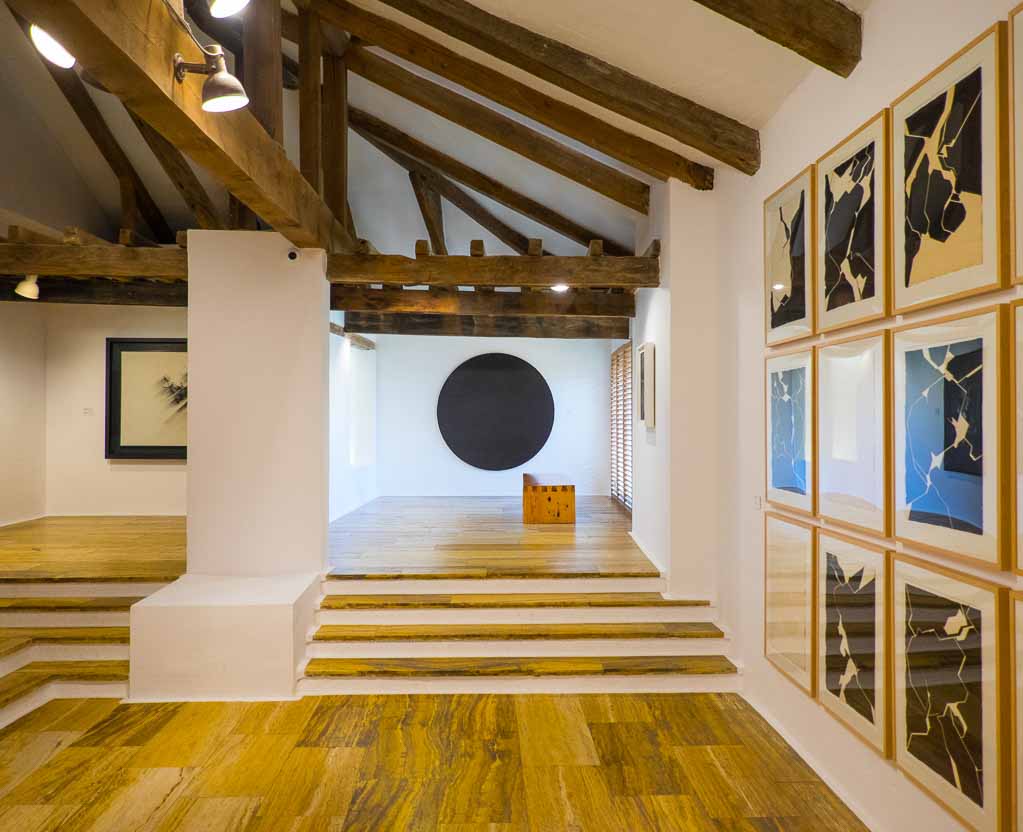
It is also the best opportunity to visit the interior of the Hanging Houses, the most emblematic and well-known buildings of the city, which look dizzyingly into the Huécar sickle.
Best place to photograph the Hanging Houses of Cuenca
An open passage under a house, the St. Paul's Shutter, takes us to the slope that leads to San Pablo Bridge.
On this descent there is the point where to take the famous photo of the Hanging Houses.
Reserve your RENTAL CAR now for your trip
Looking ahead to your trip, book your rental car now on this website that offers you the best price guaranteed and allows you a possible free cancellation in most cases. Here you have more information with tips for renting a car
Convent of San Pablo, Parador de Turismo
El San Pablo Bridge It is a narrow walkway, which can be an obstacle for people with vertigo, but it allows you to pass to the other side of the sickle, dominated by the immense Convent of San Pablo.
This building is mostly converted into Parador de Turismo, and it's possible visit the cloister area on the way to the cafeteria.

The left part of the convent is the church, which is practically overlooking the abyss of the sickle.
Torner Space, Gustavo Torner collection
Esta old church, of truly exceptional dimensions, is occupied by the Torner Space, another of the great collections of modern art that we can see in Cuenca.
It is a magnificent opportunity to appreciate the work of Gustavo Torner, a multifaceted artist who had a lot of influence on the creation of the Museum of Abstract Art and in the importance that the contemporary art in Cuenca.
Back towards the Plaza Mayor, we can go through the arches that open under the Town Hall.
Right there is the tourist office, where they care about offering us all the information we may need.

Monuments in the Plaza de la Merced
If we take the first alley on the right, we arrive at the Merced Square, one of the most attractive complexes in the old town.
Here we see the Church of La Merced, Saint Julian's Seminary and the Castilla-La Mancha Science Museum, which is in the former Homeless Asylum.
Here you have complete information and you can hire the best tours and guided visits Cuenca, as well as its surroundings, including a Complete tour of Cuenca three hours long, and excursion to the Enchanted City , and also others alternatives in English and other languages
Through a narrow alley we make out the silhouette of the Mangana Tower. It stands in an open square with good views of the surroundings.
Monument to the Constitution in Cuenca
Here we also see the remains of the synagogue and, above all, the great monument to the ConstitutionA work of Gustavo Torner which represents it as a plural structure balanced by contradictory tensions on a foundation of great firmness.

Civil War Shelters in Cuenca
If we descend towards the Alfonso VIII street, right where it makes a big curve, we will find access to the tunnels Alfonso VIII, which are named after the street where they are located and not because of the time in which they were excavated.
It is about shelters excavated during the Civil War to serve as a refuge for the population against possible air attacks.
The visit provides a new vision of the city and the lives of its inhabitants at a specific moment in its history.
The visit is guided and you have to sign up for the tourist office.
If we continue the descent, we arrive at the neighborhoods of Santa Lucía, El Retiro and Tiradores, less monumental but full of very attractive corners.

This entire itinerary refers to the historic basin which is included within the declared area World Heritage awarded by the Unesco and that logically has always been the destination of any visitor.
How to hike through the Hoces del Júcar and Huécar in Cuenca
But there are at least two aspects that we recommend adding to anyone spending a few days in Cuenca.
The first thing is to enjoy the walks in the middle of nature that can be done by Sickles of Júcar and Huécar starting in the monumental city itself.
This mix of culture and nature is unique and must be taken advantage of.
There are different marked itineraries, with the possibility of completely surrounding the historic center by going through the two gorges.

Through the Hoz del Júcar to the hermitage of San Julián el Tranquilo
Another very interesting option is to walk through the Hoz del Júcar on the way to the hermitage of San Julián El Tranquilo.
If you leave in the afternoon, we see the historic city illuminated by the sun.
Visit the Paleontological Museum in Cuenca
The last recommendation is visit the Museum of Paleontology.
All of Castilla-La Mancha, but especially the Cuenca province, abounds in paleontological findings, many of them related to the Dinosaurs.
In the museum there is a good informative tour, with original parts found in the investigated sites.

But there are also numerous life-size dinosaur reproductions, which delight everyone, especially the little ones in the family.
In the garden, facing the historic city, there is a bench that is said to have one of the best views in the world.
Map: where Cuenca is and how to get there
The city of Cuenca is one hour and 45 minutes by car southeast of Madrid, and By AVE high-speed train you can arrive in just one hour.


Comment