

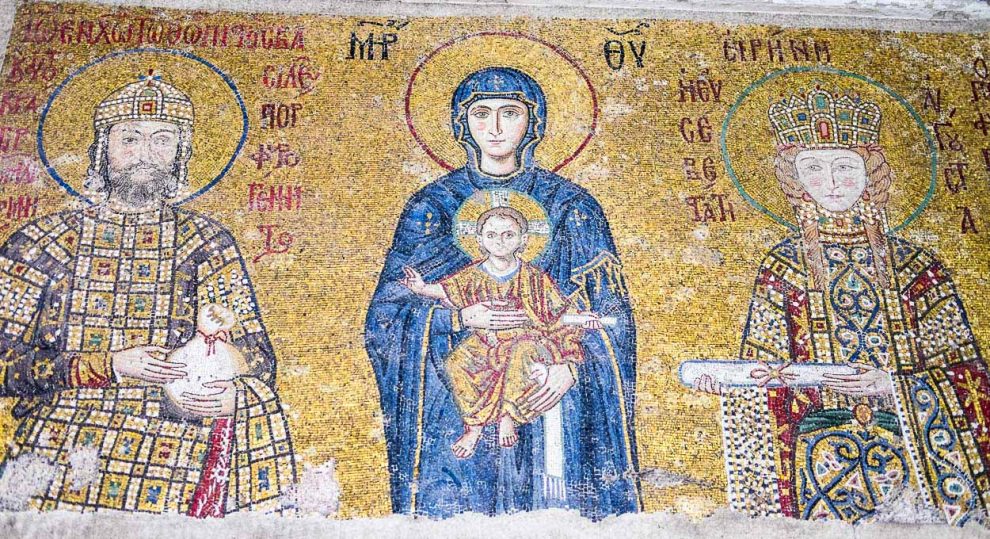

One of the main attractions of a visit to Hagia Sophia en Istanbul, in addition to its impressive set, is the search for the beautiful mosaics that are found in its walls and vaults.
El mosaic It was one of the most important art forms in the Byzantine Empire.
It represents the continuation of Roman mosaic, although the theme is absolutely different since its fundamental objective was to praise the Christian religion and the figure of the emperor.
DON'T FORGET YOUR TRAVEL INSURANCE
Are you planning your trip or getaway? Don't leave without take out your travel insurance before, and here we explain whyIf you contract it with us, you have a 10% discount with the code GUIASVIAJAR10.
As capital of Byzantine Empire for more than a millennium, in the Turkish capital We find several places that preserve very important mosaics.
In addition to Hagia Sophia, we can remember the church of San Salvador in Chora and the Grand Palace Mosaic Museum.
All the information in detail
History and curiosities of the Hagia Sophia mosaics
La Hagia Sophia Basilica, ordered to be built by Emperor Justinian, is undoubtedly one of the most splendid monuments in history.
It is stated that originally the entire interior - the dome, the two semi-domes, the tympanum and the covers of the narthex, the corridors and the galleries -, an area of 16.000 square meters, was covered with gold mosaics.
A chronicle of the time compares its splendor to the brightness of the midday sun in spring.
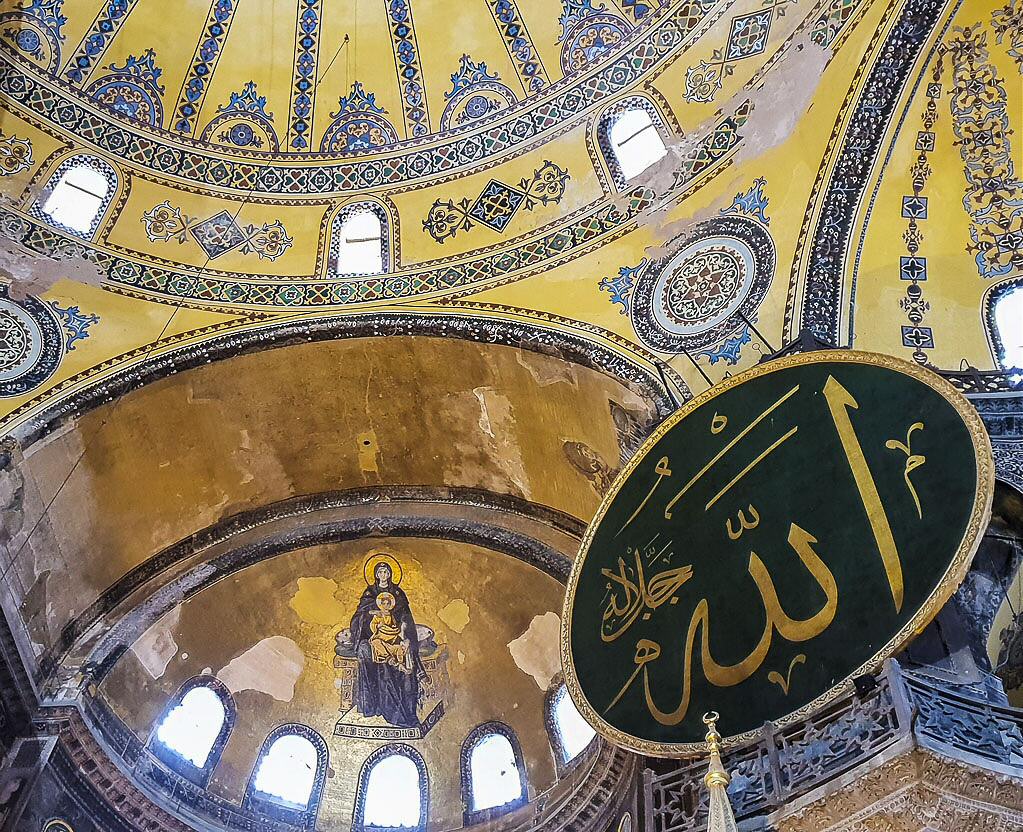
There was, therefore, no mosaics with human figures in the first centuries of the temple's history.
Parts of the original mosaics in the vaults of the narthex and some corridors, and consist of gilded surfaces with some geometric and floral decorations.
The first mosaics with human figures that may have been installed after the time of Justiniano, in the unlikely event that they had existed, they would have been destroyed during the iconoclastic period that lasted from the year 729 to 843.
Those we see today are therefore after that time and created over several centuries.
What are the mosaics of Hagia Sophia like?
Most mosaics with figures were covered by plaster or other materials during the centuries when Hagia Sophia It functioned as a mosque.
Those we know now were rediscovered in restoration work over time since the building became a museum.
Mosaics of the Imperial Gate of Hagia Sophia
The mosaics that appear as we complete the route are one of the most attractive points of the visit.
Tips for your trip to Istanbul: it will be very useful to you purchase an eSIM card in advance to have Internet on your mobile, and you should evaluate if it is worth it for you to have the Istanbul E-Pass card which gives you free access to more than 60 attractions for 2 to 7 days
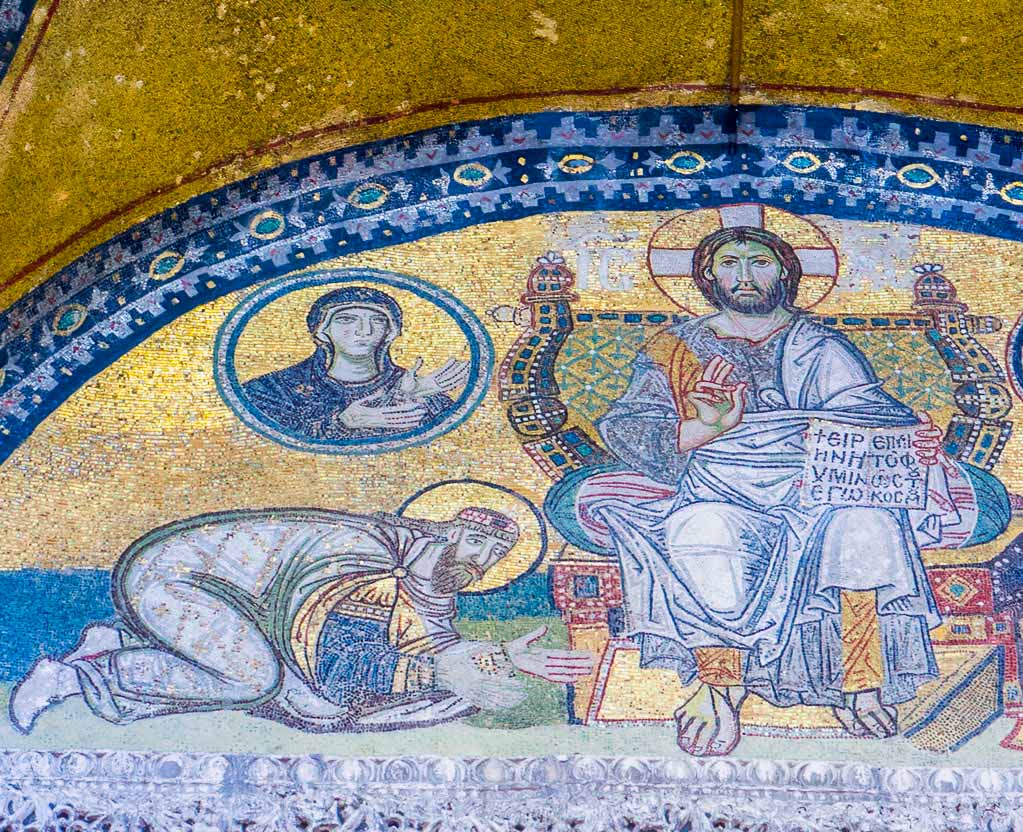
Upon entering the basilica, the first mosaic we see is above the Imperial Gate and appeared during the works in 1933.
The mosaic shows Christ sitting on a very luxurious throne while holding a book with his left hand and raising his right hand in a gesture of blessing. In the book you can read, in Greek, “Peace be upon you. I am the light of the world".

To his right an emperor appears prostrate in a gesture of supplication, and on both sides of the throne emerge The Virgin and an angel on two discs.
There is no security, but the emperor represented is supposed to be Leo VI the Wise and that the mosaic belongs to his time of rule, at the end of the 9th century.
The cover of the narthex largely preserves the original mosaics from times of Justiniano, golden and with some geometric and floral motifs.
ORGANIZE your TRIP
- Don't forget your TRAVEL INSURANCE with a 10% discount
- Book the HOTEL for your trip
- eSIM card to have INTERNET at a discount
- The best TOURS and EXCURSIONS in Spanish
- TOURS and ACTIVITIES in English and other languages
- NO-LINE TICKETS for museums and monuments
- RENT a CAR for your trip
- Has your flight been cancelled? How to claim compensation
- Book your TRANSFER from the airport
When crossing the Imperial Gate We access the main nave.
Very few of the many mosaics that must have adorned this majestic space have been preserved, and an interesting anecdote that appears in different chronicles is that it was very common to hear the tinkling sound produced by the gold tiles of the mosaics on the roof when they fell to the ground from Heights.
What is the largest mosaic in Hagia Sophia?
The largest of the mosaics It is the one that is preserved in the apse, and it is also one of the most beautiful.
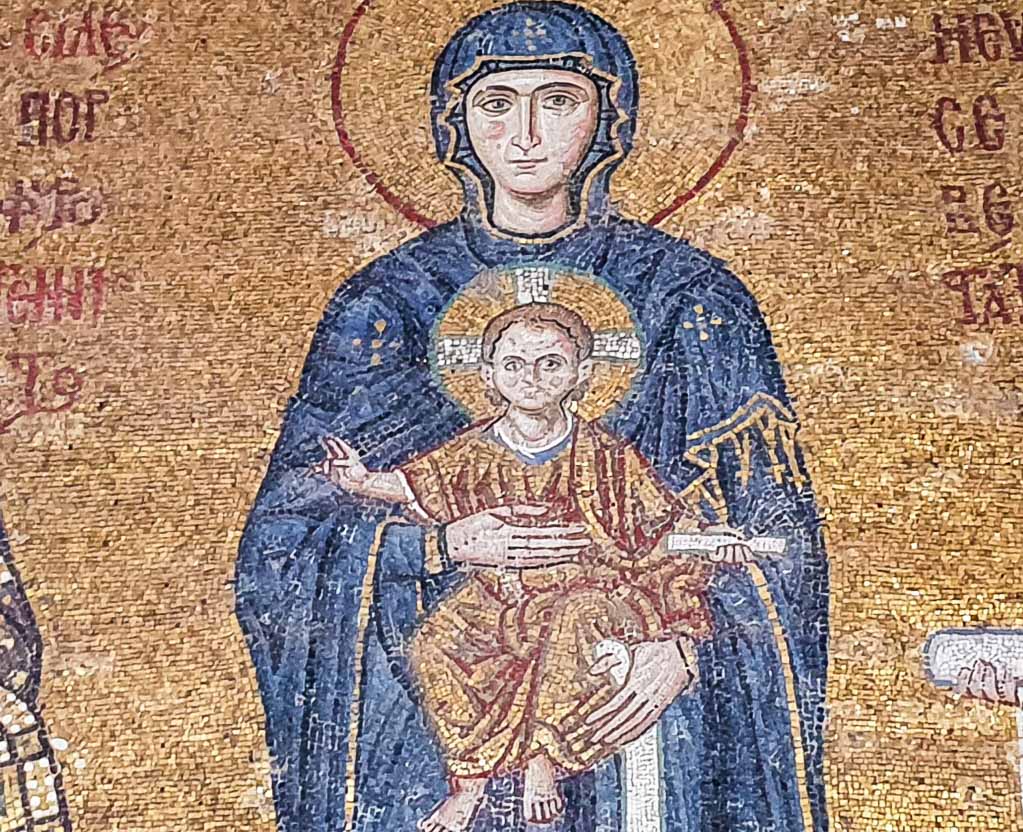
It represents la Madre de Dios with the child on his knees and the amount of detail is amazing.
The Virgin She is dressed in blue with small golden crosses in the folds of the cloak over her head and shoulders, while the child He is dressed in gold and curiously is wearing sandals.
She is on a seat adorned with jewels and appears comfortably supported on two cushions of different design and decoration, and with her feet resting on a footrest equally studded with jewels.
In the arch that frames the apse there was two archangels, Gabriel y Miguel, although there are hardly any traces of the second.
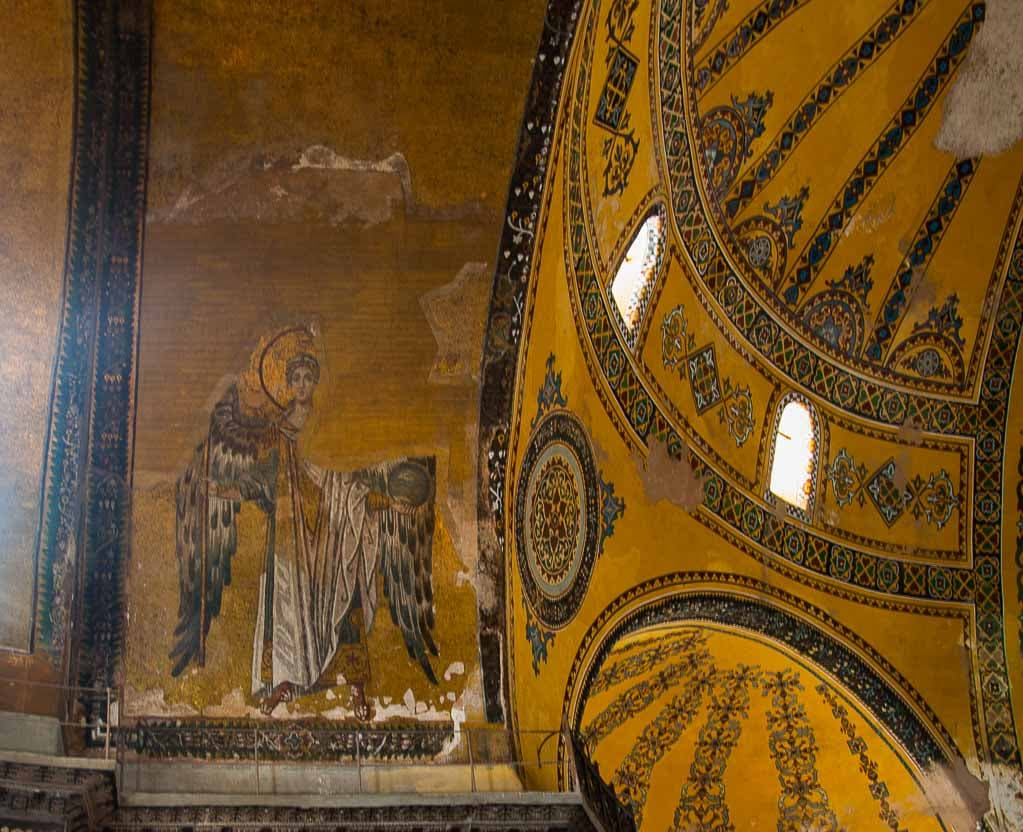
Although damaged, the image of Gabriel It shines in its splendor, and despite the distance from which it must be observed, it still shows a thousand details.
For example, the two types of tunics he wears, one on top of the other, and his wings, which almost reach his feet, are made of very bright white, green and red feathers.
In his right hand he holds a cane and in his left a crystal ball, and his face is, for many scholars, the most beautiful of all those preserved in Hagia Sophia.
These mosaics were unveiled in a great ceremony on Easter Sunday of the year 867 that showed the world the triumph of orthodoxy over the iconoclasts and celebrated the restoration of religious images to the churches of Byzantium.
Tympanum mosaics of Hagia Sophia in Istanbul
In the main nave there is three mosaics in the niches located in the bottom of the eardrum (the semicircular wall) north.

Represent three bishops of the early church: Saint Ignatius the Younger, saint john chrysostom y Saint Ignatius Theophorus.
On our last visit, only the first one was visible since scaffolding hid the other two. These three are the only ones preserved from the 16 prophets of the Old Testament y 14 Fathers of the Church that was in both eardrums centuries ago.
If you prefer to visit the Turkish capital in the company of a guide in spanish, here you can sign up for one guided tour of the essentials of Istanbul, or yet 2-day full tour of Istanbul, and you also have the option of a free tour of Istanbul
The other mosaics that can be seen in the ship are the seraphim o cherubs of six wings of the eastern pendentives.
It must be remembered that those on the western pendentives are painted copies made by the Fossati brothers during restoration work in the mid-19th century.
Mosaics from the upper floor of Hagia Sophia
To search for others mosaics must go up to the upper floor.
The oldest is the one that appears in the north gallery, which in turn was the last to be discovered and restored. Represents the Emperor Alexander with a fabulous outfit.
The most famous mosaics They are on the walls of the south gallery, and the first one we find is the one called Deesis o Prayer.
Book your hotel, 15% discount, free cancellation
When planning your trip, we advise you to, well in advance, Book your hotel now on booking.com where you can find discounts from 15% and you will have a possible cancellation for free
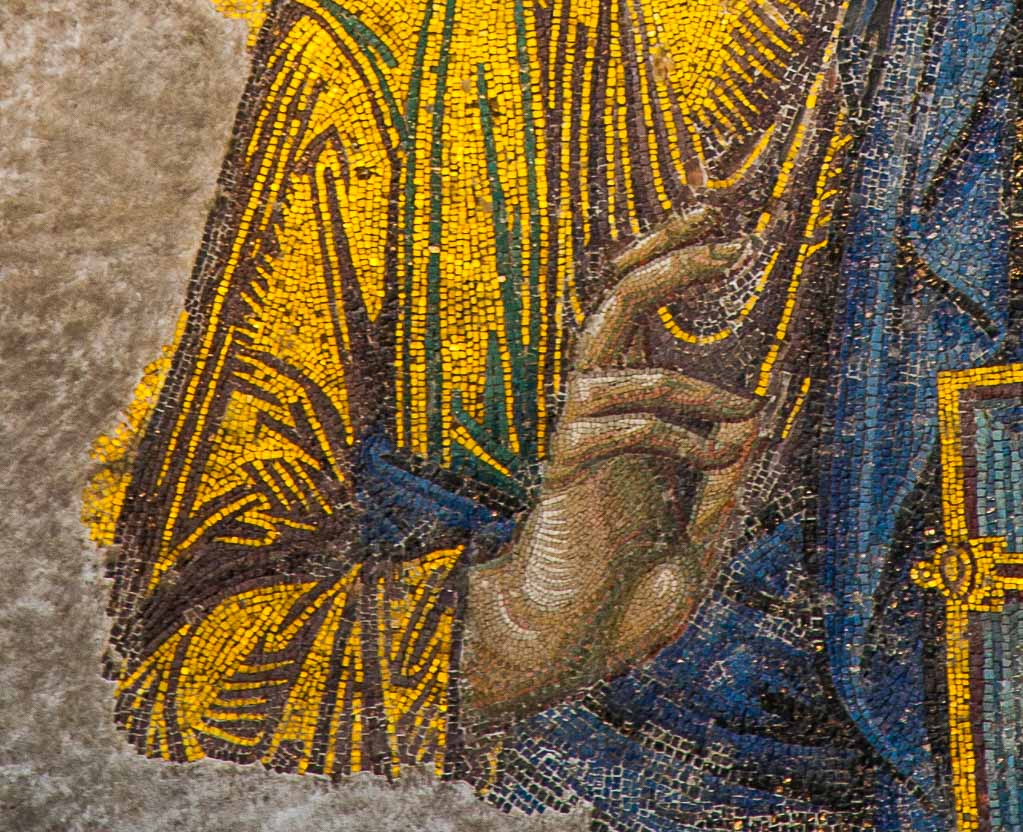
At Christ He appears with a halo in which a cross is inscribed and makes the sign of blessing with his right hand, while with his left he holds the Gospels.
It is flanked by lto Virgin y Saint John Baptist who beg him for the souls of sinners in the doomsday.

The lower part of the mosaic is very deteriorated, but you can still admire the realism of the clothing and the great expressiveness of the faces.
It is dated to the end of the 12th century and the evolution can be seen on other older mosaics in which the figures are hieratic and very little expressive.
At the back of the gallery there is two mosaic panels that exalt the power of the emperors.
In the one on the left we find Christ flanked by Constantine IX Monomachus and Empress Zoe.
The emperor displays a purse, representing his monetary offerings, while the empress carries a scroll recording the donations to the basilica.
The mosaic on the right reproduces a similar scheme.
In this case it is the Virgin with the Child which appears accompanied by John II Komnenus e Irene. The details of the empress's face, with her blonde braids and gray eyes, reflect her Hungarian origin.
Right next to it the mosaic continues along the pilaster and there appears the son of the royal couple, the young man Alexis Comnenus who died shortly after his accession to the throne.
Reserve your RENTAL CAR now for your trip
Looking ahead to your trip, book your rental car now on this website that offers you the best price guaranteed and allows you a possible free cancellation in most cases. Here you have more information with tips for renting a car
Already in this portrait he shows a rather unhealthy appearance.
The last of the mosaics that can be admired is already at the exit.

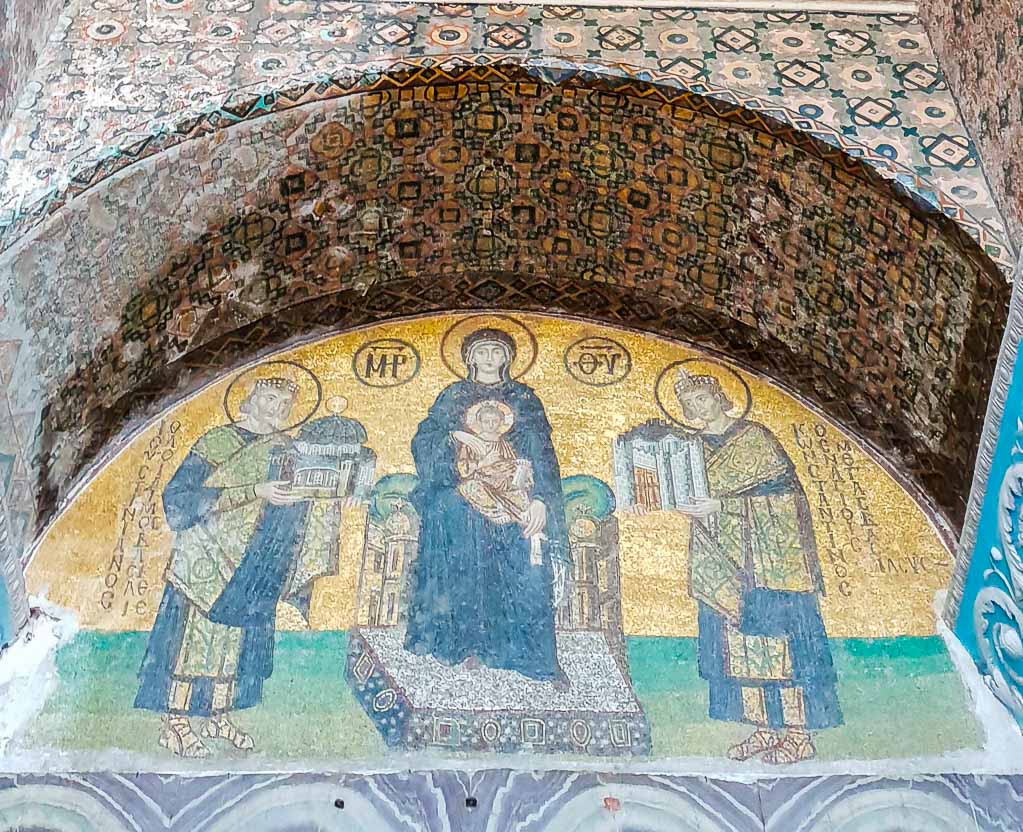
It is located in the lunette above the door that opens from the inner narthex to the Warriors Lobby. There it appears la Mother of God with Child on his lap while receiving two emperors in audience.
They are not just any two. To your right we find Constantine the Great, which Constantinople offers him, and on his left to Justiniano, which presents you Hagia Sophia.
The representations of the city and the church are ideal and do not correspond in the slightest to reality.


Comment